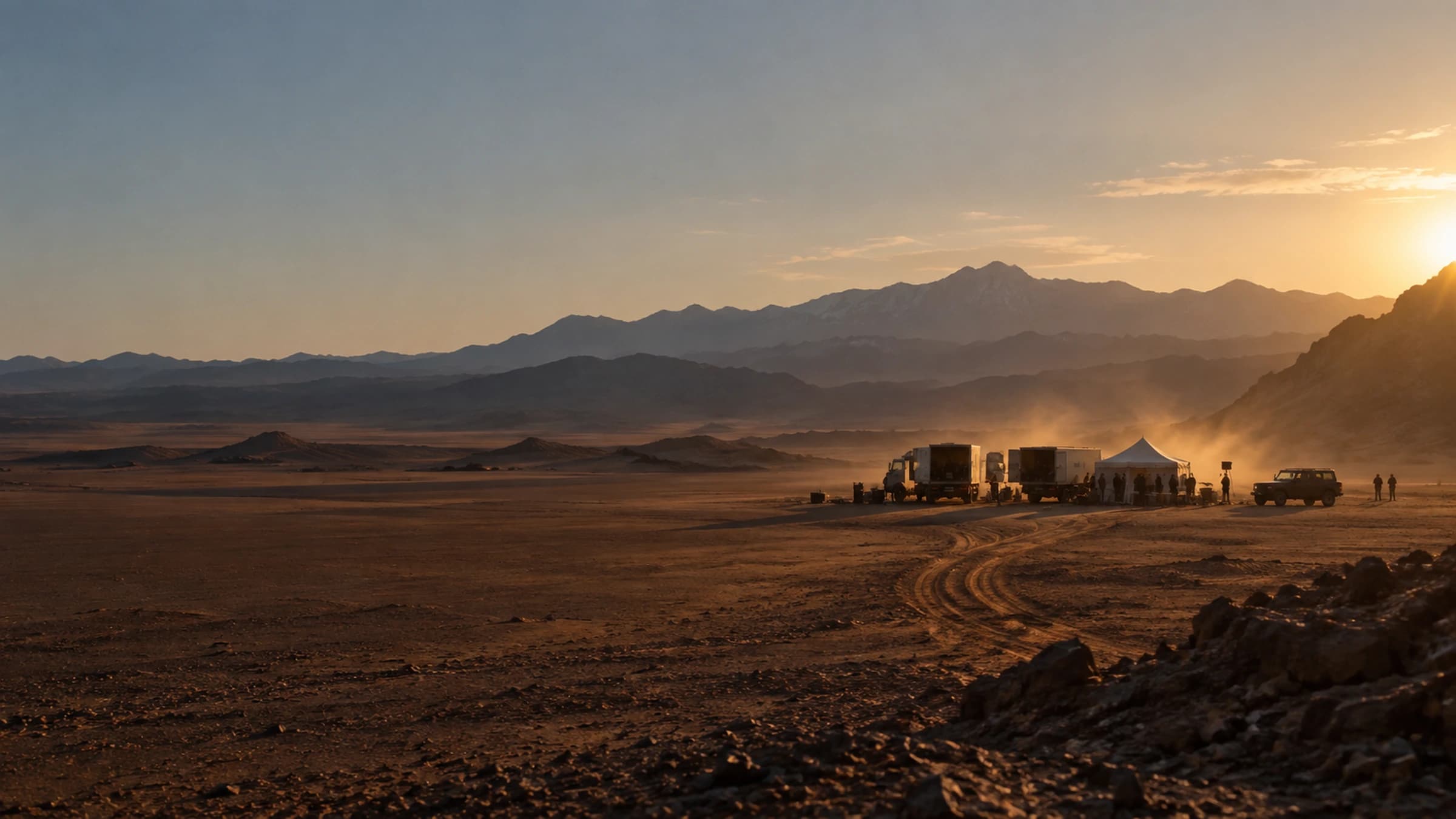
The Centre cinématographique marocain (CCM) sums up its location offer in a single sentence that doubles as a manifesto: “Snow-capped mountains or sand desert, Arabian Nights palace or Art deco buildings, Kasbah or Californian villa, ultra-modern airports or fishing village.”
The argument is not exoticism but density. A single country supplies visual worlds that most territories force a production to go and find across several continents, and it supplies them with a single permitting chain and local crews.
Aït Ben Haddou and the Ounila Valley
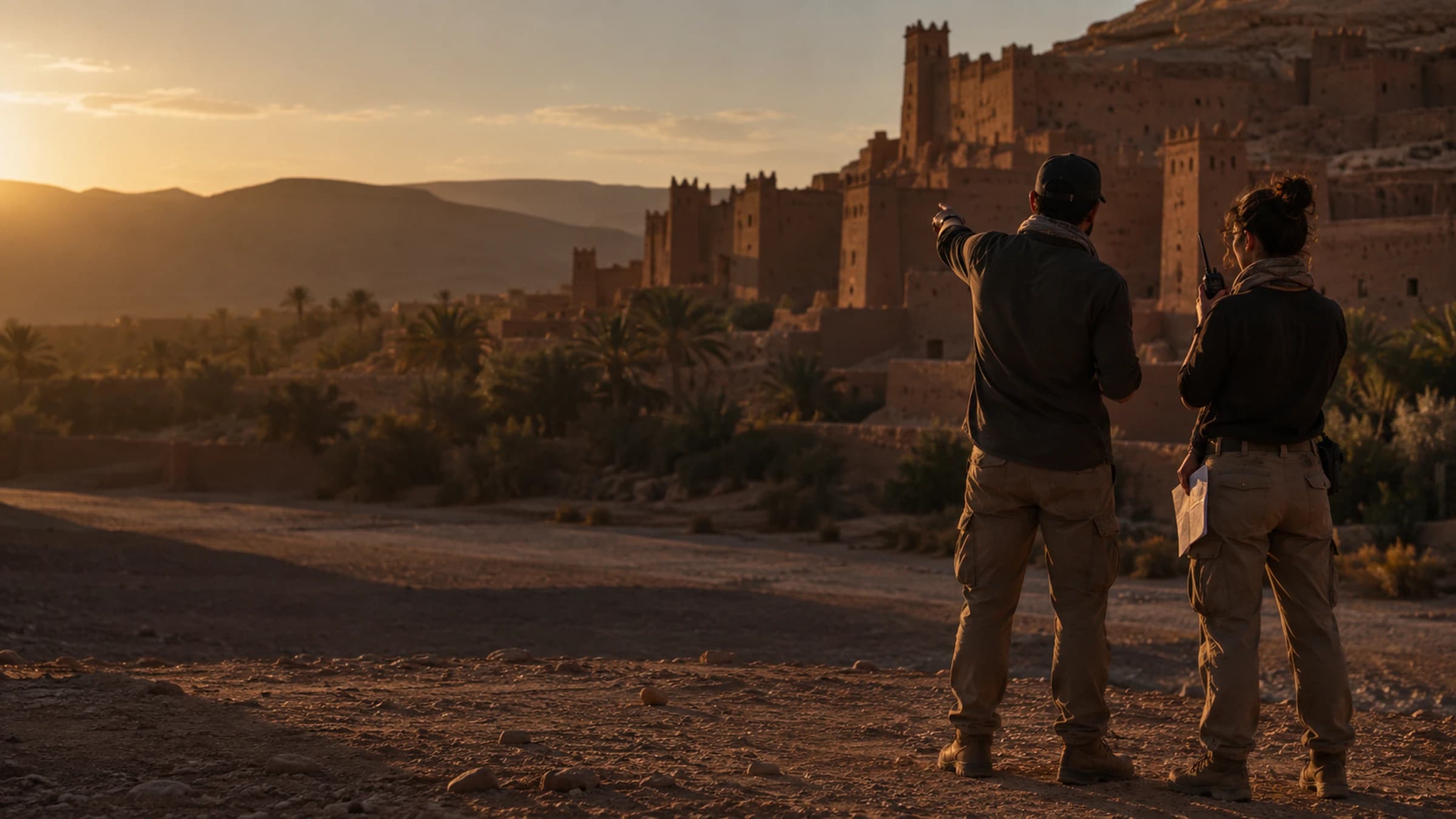
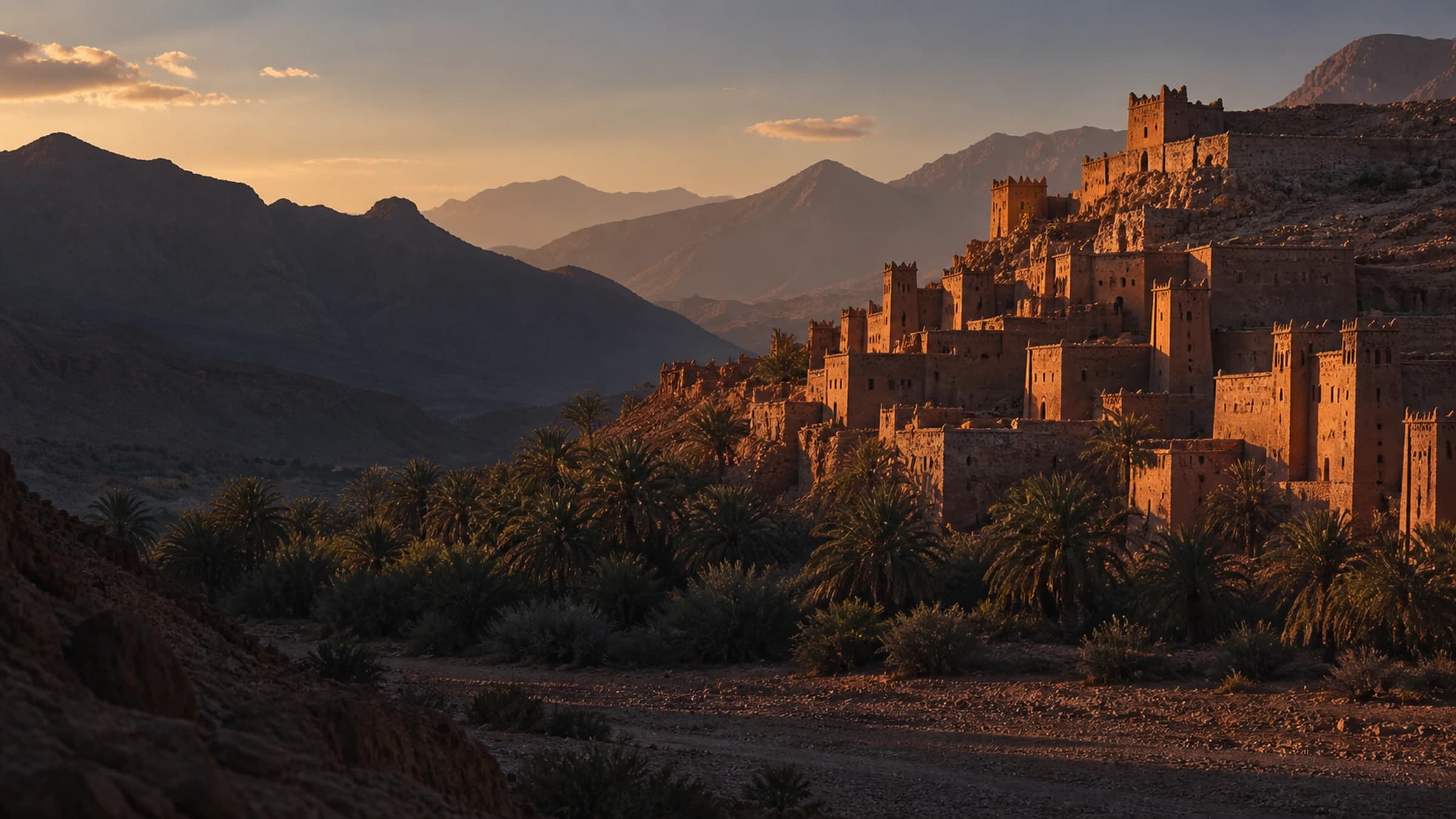
The ksar of Aït Ben Haddou has been inscribed on the UNESCO World Heritage List since 1987, under criterion (v), as an example of traditional pre-Saharan rammed-earth settlement. It stands in the Ounila Valley, on the southern slope of the High Atlas, in the province of Ouarzazate.
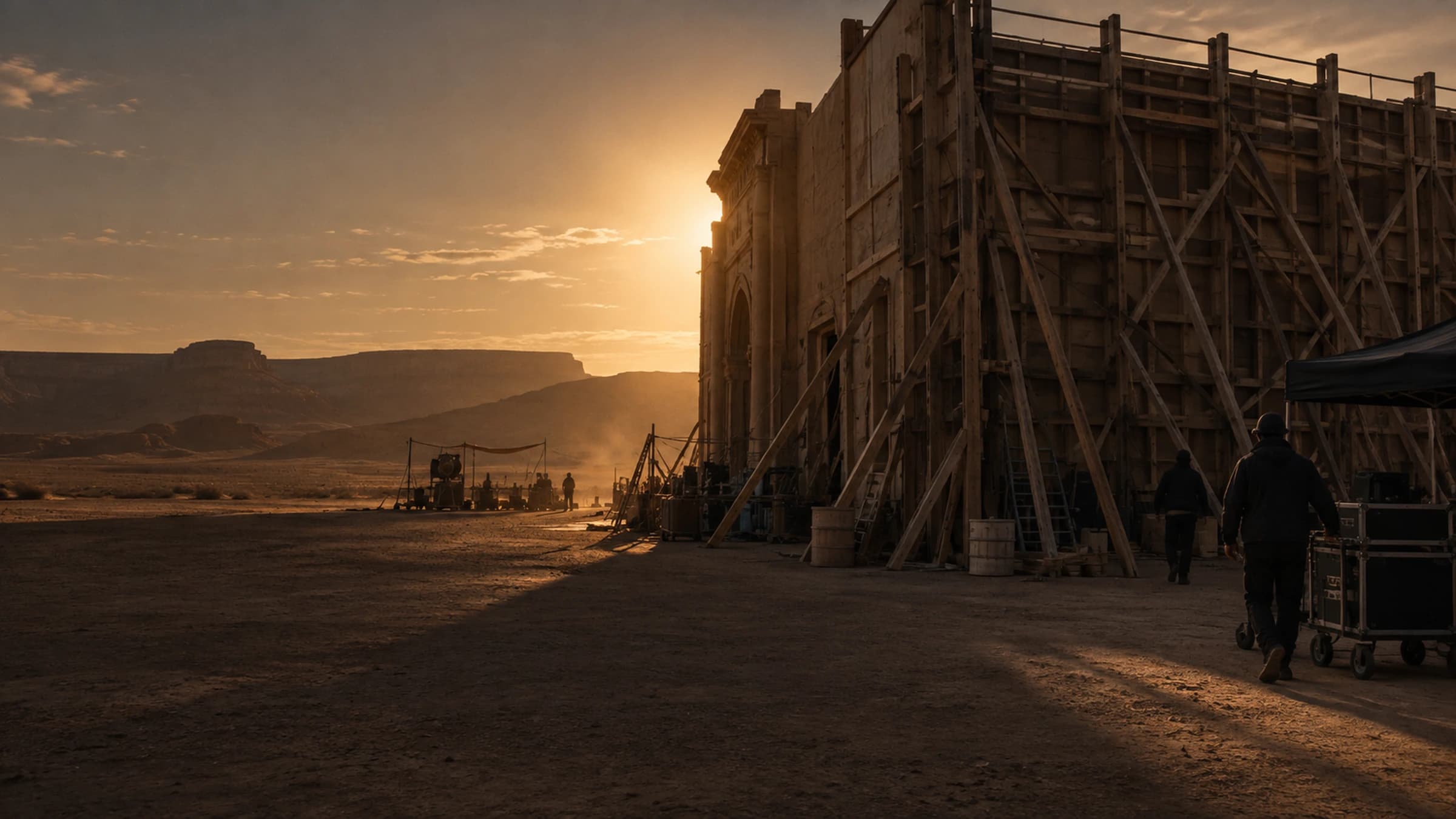
What the site allows at the scale of a large production is documented by the shoot of The Odyssey by Christopher Nolan, where the ksar stands in for Troy. Beyond the existing ramparts, the production temporarily erected some sixty additional structures, among them a columned temple of Athena and the gates of the city, across roughly one hectare, or 10,200 m².
Aït Ben Haddou is among the longest-serving locations in the country: Lawrence of Arabia shot there in 1962, Jesus of Nazareth in 1977, Kundun in 1997.
Ouarzazate and the South
Ouarzazate is the only place in the country that combines working studios, kasbahs and direct access to the desert. The Moroccan press presents it as “the Hollywood of Africa”, and the CCM lists several studios there: Atlas, CLA, Kan Zamane, Cinedina and Ester Andromeda.
Gladiator II shot there from June 2023, including the naval invasion of Numidia that opens the film. The production worked in temperatures that regularly reached 35 °C, a scheduling parameter as much as a question of comfort.
The Atlantic coast: Essaouira and Dakhla
Essaouira combines a long Atlantic beach with Portuguese ramparts. On The Odyssey, the beach hosts the Trojan horse buried in the sand and the departure of Odysseus's ships. The town was also the main shooting location for the series Flight 103, about the Lockerbie bombing.
Dakhla offers something else: the White Dune, which advances into the lagoon until it forms an islet, served as the location for Ogygia, Calypso's island. The contrast between white sand and the turquoise Atlantic has no equivalent anywhere else in the country.
The medinas: Tangier, Chefchaouen, Marrakech
Moroccan medinas are used less to play Morocco than to play somewhere else. The medina of Tangier was turned into Beirut for the second season of The Terminal List; the city also hosted the reconstruction of an Algiers district for a biopic about Charles de Gaulle.
Chefchaouen and its blue medina hosted a Russian feature for about fifteen days, with several hundred Moroccan extras. The town was chosen explicitly for the vividness of its colour, its traditional architecture, its narrow streets and its natural light.
Marrakech most often serves as a logistics base as much as a location: the city hosted sequences of The Odyssey and acted as the anchor point for the second season of The Terminal List.
The contemporary city: Casablanca, Rabat, Kenitra
Casablanca provides what the South cannot: a dense port city, Art deco architecture and an industrial fabric. Mission: Impossible – Rogue Nation shot a motorcycle chase there running from the city out towards the desert, and a substantial part of the second season of The Terminal List was shot there.
Rabat and Kenitra are among the cities named in recent international shoots, alongside Casablanca and Marrakech.
The Atlas Mountains
Mountain terrain, and snow in season, are part of the offer the CCM explicitly promotes. The Odyssey shot at Tahanaoute, in the province of El Haouz, and the second season of The Agency also worked in the Atlas Mountains.
What that concentration changes in the shooting schedule
The value of this geography is not aesthetic, it is budgetary. Very different visual worlds can be served from a small number of base camps, which compresses travel days, often the heaviest hidden line item on a location shoot.
The Odyssey gives the clearest illustration: Marrakech, Tahanaoute, El Haouz, Essaouira, Ouarzazate and Dakhla on a shoot spread from February to August 2025, standing in for Troy, the sea, an island and a desert, without leaving the country or changing regulatory framework.
Morocco is also the country of focus at the European Film Market 2026, which gives a sense of the territory's current visibility among European buyers and financiers.