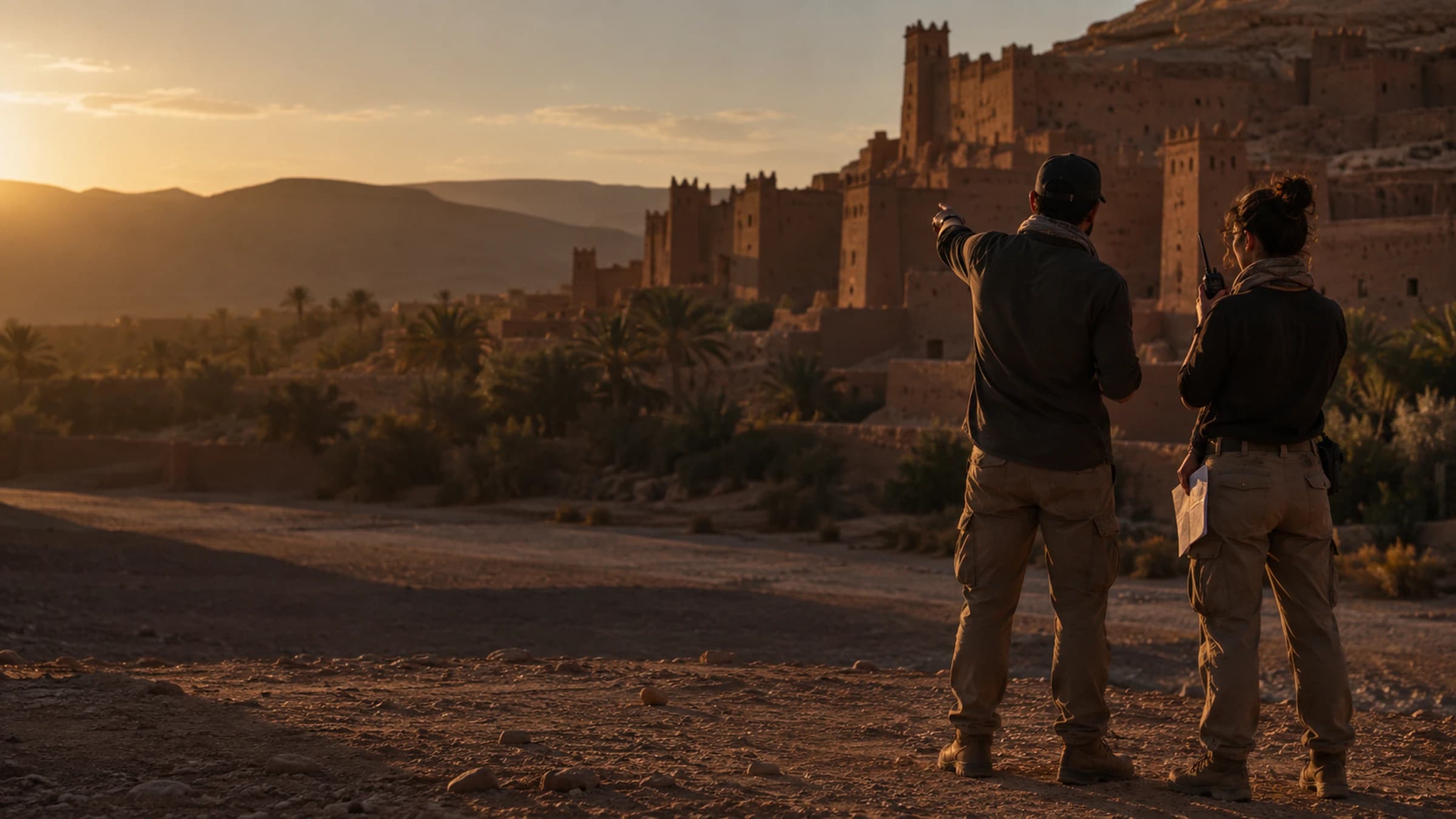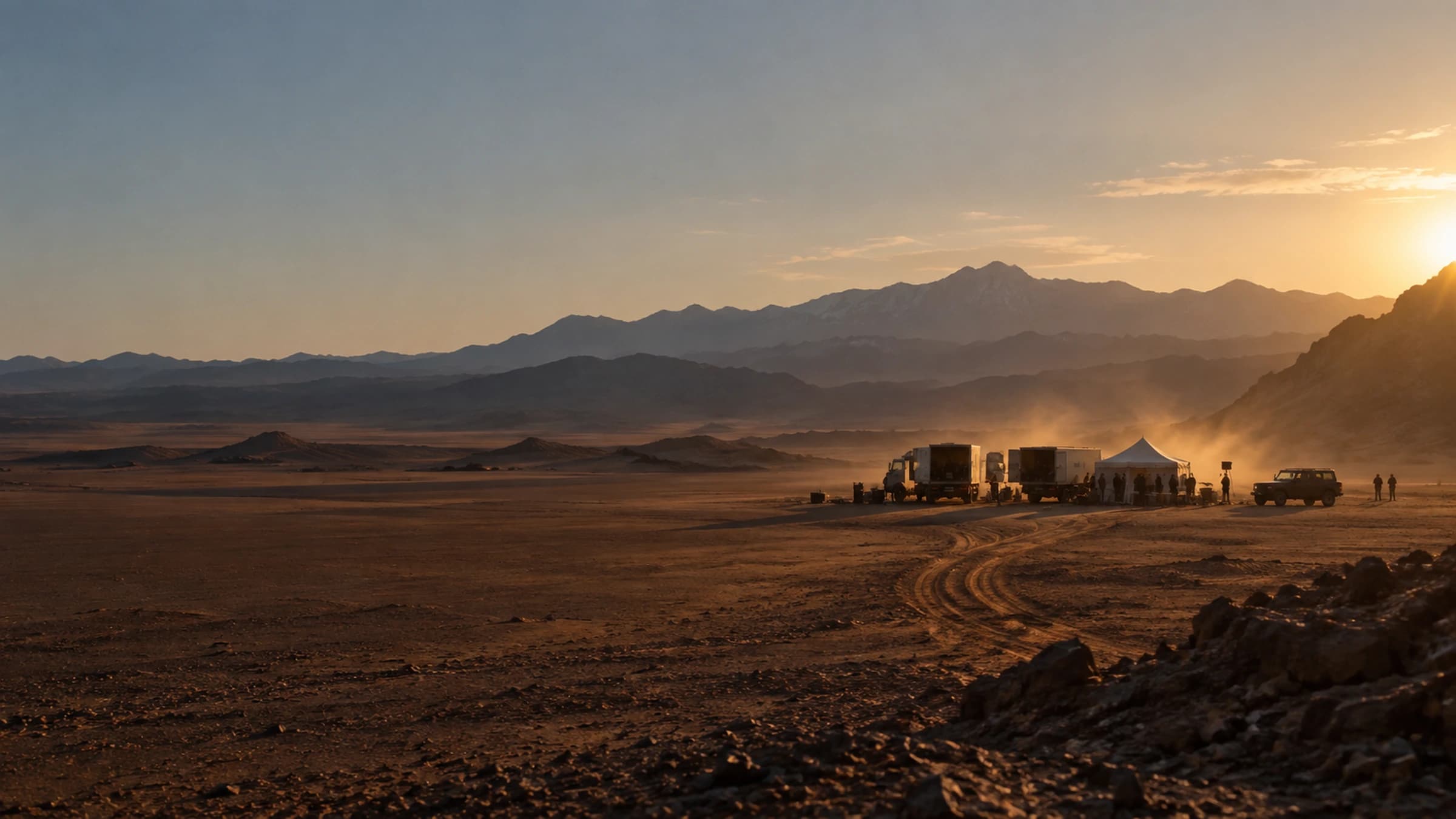
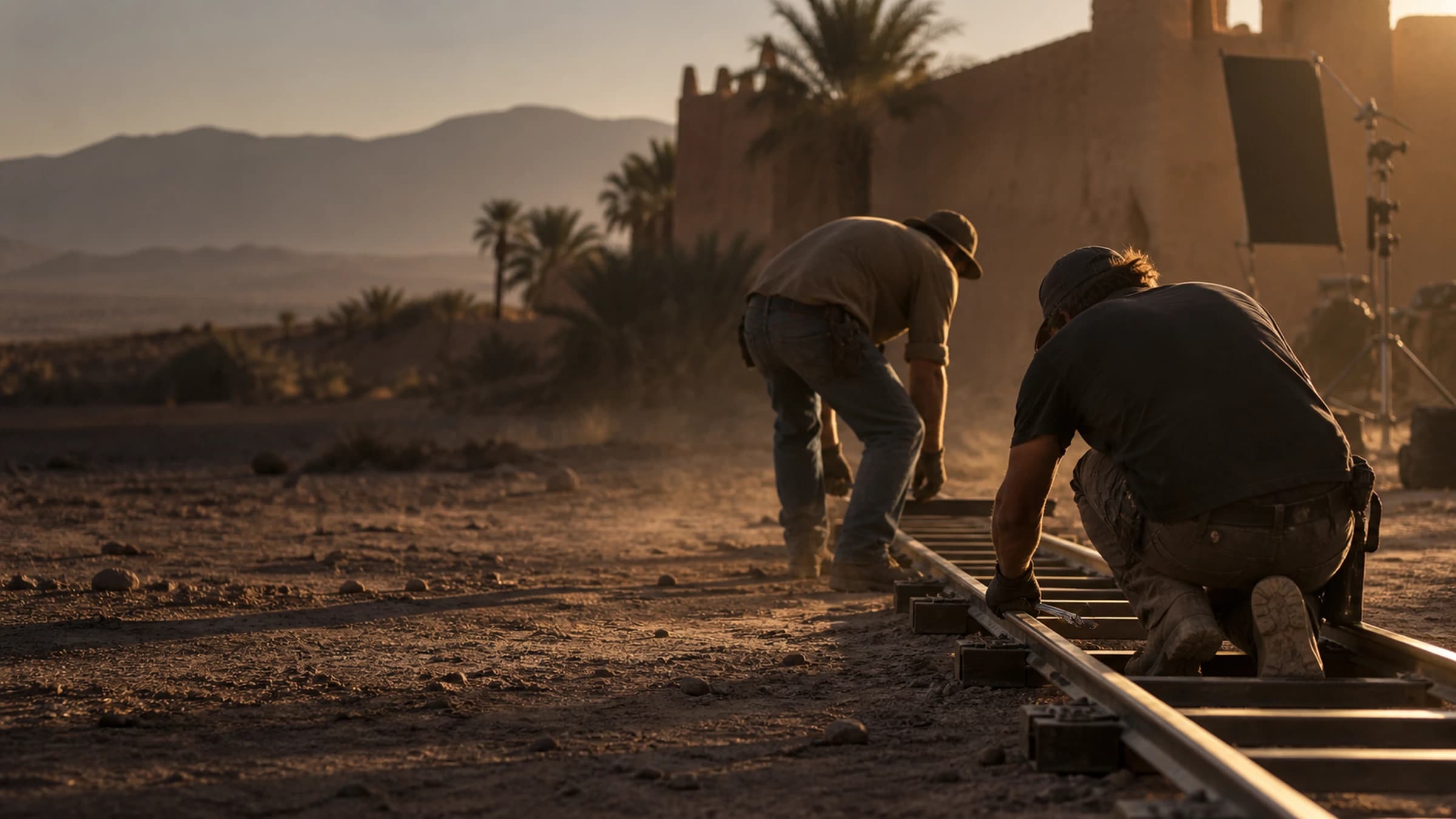
A shooting territory is judged less by its landscapes than by the depth of its crew pool. A country without crews forces a production to move fifty people; a country with crews allows it to move ten. The difference reads straight across the budget, the travel plan and the length of prep.
A pool kept busy all year round
The availability of technicians does not depend on foreign shoots alone. In 2025, Moroccan national production accounted for 596.48 million dirhams, and 26 Moroccan feature films were completed.
The volume of permits issued in the same year gives a more concrete sense of the real level of activity, across all formats:
| Format | Number |
|---|---|
| Commercials | 116 |
| Short films | 104 |
| Feature films | 34 |
| Television series | 22 |
| Sahrawi documentaries | 20 |
| Corporate films | 20 |
| TV films | 16 |
This continuous activity is what separates a crew pool from a mere labour catchment. The 116 commercial shoots, excluded from the support scheme, play a discreet but real role here: they keep crews and rental houses working between two large international productions.
The series effect
In 2025, television series alone accounted for more than 705.5 million dirhams of foreign spend, ahead of feature films at close to 421.8 million.
That shift matters for crews. A series comes back, second season, third season, to the same locations, with the same suppliers and often the same technicians. It is the format that professionalises a territory fastest, because it establishes working habits instead of creating isolated peaks.
The Moroccan technician quota
This is the most structuring obligation for a hiring plan, and the most poorly reported online. The Centre cinématographique marocain (CCM) publishes, department by department, the minimum share of Moroccan technicians a foreign production must employ, along with a minimum number of Moroccan trainees.
| Field of specialisation | Moroccan technicians | Trainees |
|---|---|---|
| Production management | 30% | At least one |
| Camera | 30% | At least one |
| Sound | 30% | At least one |
| Art department (set design) | 30% | At least one |
| Lighting and grip | 30% | At least one |
| Directing | At least two | At least one |
| Costume | At least two | At least one |
| Hair | At least two | At least one |
| Location management | At least one | At least one |
| Special effects | At least one | At least one |
| Make-up | At least one | At least one |
| Artistic services direction | At least one | At least one |
There are two ways to read this table. The first is regulatory: local hiring is not a preference, it is a condition. The second is budgetary: these thresholds are reachable precisely because the pool exists, and the trainee obligation feeds that pool shoot after shoot.
Training
Two institutions structure training in the technical trades:
- ISMAC, the Institut supérieur des métiers de l'audiovisuel et du cinéma, created by decree of 15 March 2012 and based in Rabat. A public institution under the supervision of the ministry responsible for culture and communication, it is the only public institution of its kind in Morocco.
- ESAV Marrakech, the École supérieure des arts visuels, oriented since 2006 towards the professionalisation and employment of its students, training directors, technicians, graphic artists and designers.
The International Cinema City project launched in Ouarzazate in 2026 provides for a training cluster, which would extend this chain to the immediate vicinity of the stages.
Professional regulation
The CCM keeps a national film register and issues a professional card (carte professionnelle) covering twelve trades: directing, production, camera, sound recording, editing, set decoration, costume, make-up, hair, electrical and grip, casting, special effects. The contracts signed with crew members also form part of the shooting permit application: crews are not merely hired, they are declared.
It is the Moroccan production partner that contracts with local technicians and carries the corresponding social security obligations. The link to the support scheme is direct: payment of the rebate requires that all debts owed to suppliers and crews in Morocco have been settled in full.
Working conditions
The international trade press notes two characteristics of the Moroccan market: crews that work six days a week, and costs below those of their Western equivalents.
The six-day week is not a scheduling detail. On an eight-week shoot it changes the number of usable days available and therefore the way the schedule is built. It is set out in contract, and it should be verified with the partner.
What still has to be imported
No territory supplies everything. An international production generally continues to bring in its senior team, directing, camera, production and art department, and hires locally for the executing positions, location management, grip, electrical, construction and extras.
The right question to put to the executive producer is therefore not “do you have crews?” but “which specific positions can you cover locally in the period I am targeting, and which do I have to bring in?”. The answer varies with the season and with the shoots already committed in the region.
In practice
The Moroccan pool is real, sustained by continuous national production and by a dense flow of commercials, and structured by two schools and a professional register. Its availability, however, is never general: it is verified position by position, on a given date, with a partner who knows the state of the local market.